

Appearance
OSCUR
Cyberinfrastructure
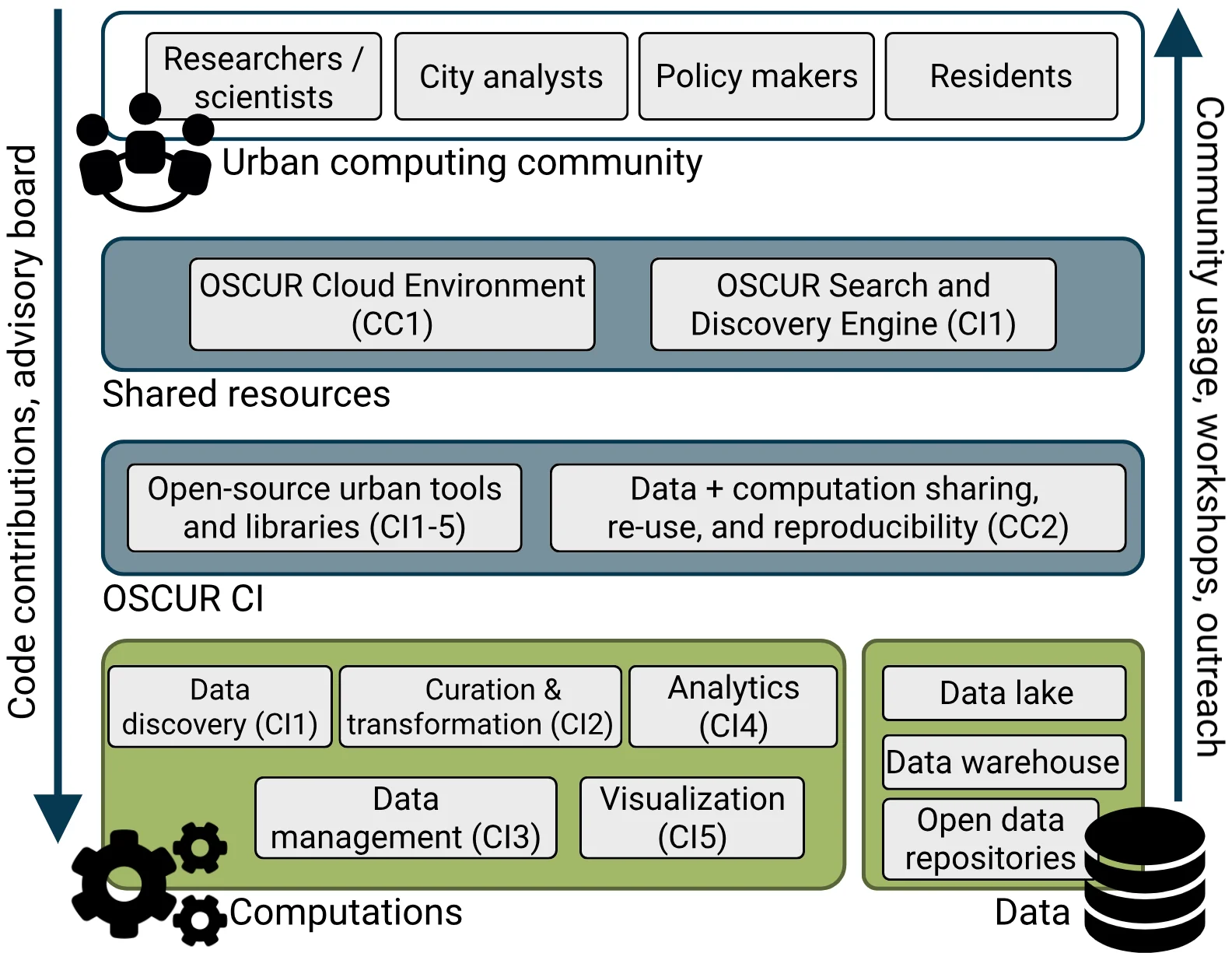
We propose a plan organized into work packages, 5 corresponding to major CI components (CI), and 2 cross-cutting ones (CC). In what follows, we outline the directions and tasks we will follow for the design and implementation of the CI.
- (CI1) Collection, Generation, and Discovery
- (CI2) Curation and Transformation
- (CI3) Data Management
- (CI4) Analytics and Predictive Modeling
- (CI5) Interactive Computing and Visualization
- (CC1) Cloud-Based Collaborative Environment
- (CC2) Transparency, Reproducibility, and Trust
Community Building, Outreach and Education
Fostering Close Collaborations Among Stakeholders
To help ensure a sustainable future beyond the initial project timeline, we will also align the development of our software infrastructure with the needs and use cases of researchers and municipal agencies, using Chicago, Seattle, and NYC as test cases. In Y1 and Y2, workshops will be held in NYC. The experience from these workshops will inform the design of the subsequent workshops to be held in Seattle focusing on accessibility, and Chicago focusing on urban planning. A final workshop to draw together themes and experiences will be held in NYC. Each workshop will have a principal local stakeholder partner, but will additionally draw on the expertise of the collaborators that have demonstrated a keen interest in our outcomes.
| Year | Location | Theme | Partners |
|---|---|---|---|
| Year 1 | New York City | Transportation | TBD |
| Year 2 | New York City | Sensing | TBD |
| Year 3 | Seattle | Accessibility | TBD |
| Year 4 | Chicago | Planning | TBD |
| Year 5 | New York City | Planning | TBD |
Education and Mentoring Activities
We will implement an internship program to host graduate students from collaborating groups at our institutions. The interns will work in close collaboration with OSCUR’s software engineers and PIs and participate in the team’s meetings. In doing so, our goals are to (1) better align our development goals with the actual requirements from domain experts, (2) stimulate the usage of OSCUR by the urban science community, and (3) disseminate knowledge about software development and urban computing.
Curriculum development
We will leverage the project’s outcomes to develop new courses and update existing ones taught by the PIs.